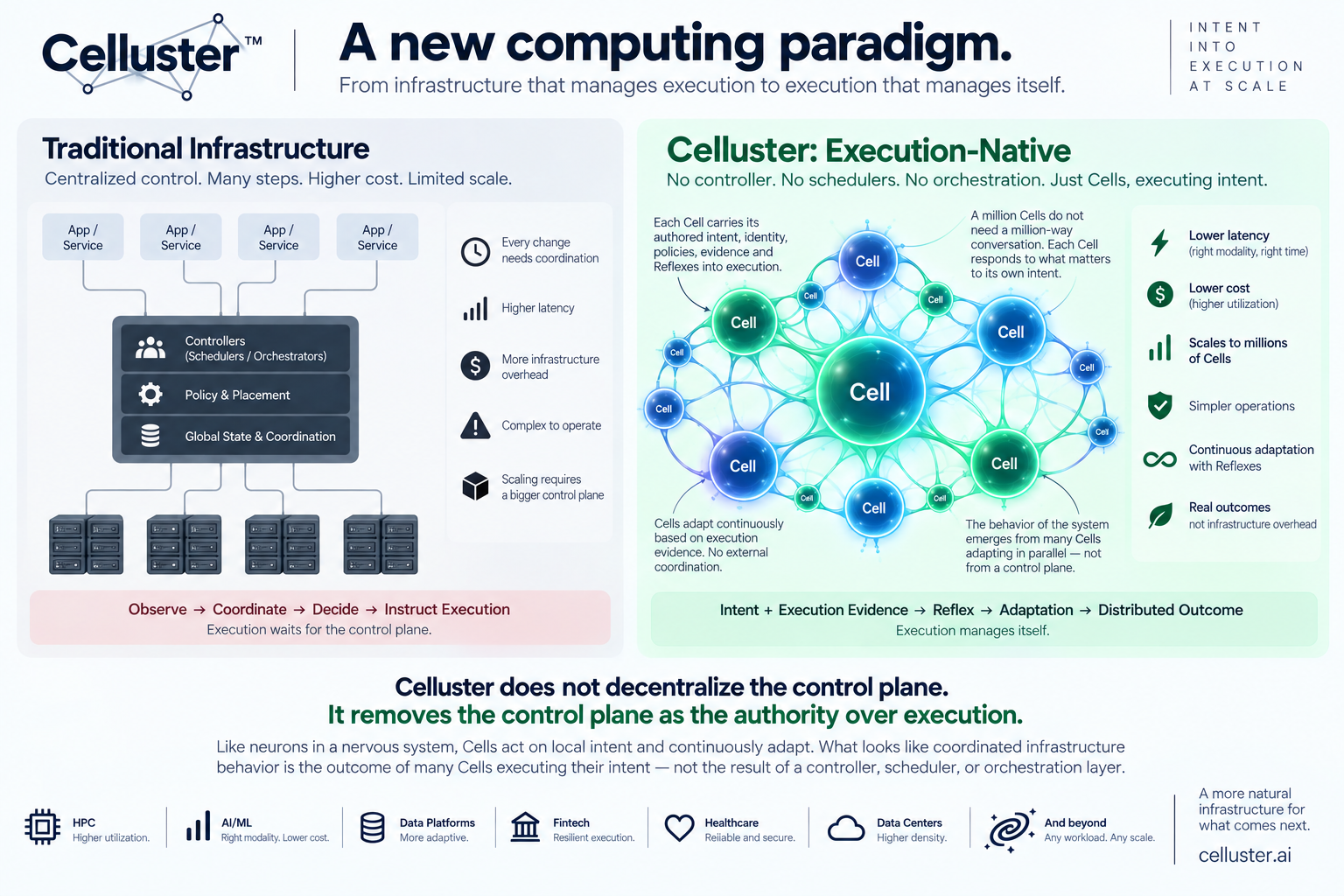
Celluster™
Execution-Native Semantic Compute • Reflex-Native Compute Substrate • Self-Evolving Infrastructure
Design Partner Program • Execution Authoring Preview • Enterprise & Academic Collaboration
Execution-Native Semantic Compute

Celluster™ The Reflex-Native Compute Substrate for Self-Evolving Infrastructure

Celluster is a self-evolving infrastructure platform powered by execution-native semantic compute, where intent is baked into execution through a reflex-native compute substrate instead of reactive control loops. Current exisitng infrastructures has been built around identity. Celluster binds identity to executable intent, allowing execution to adapt across agents, clouds, GPUs, and runtime without losing its purpose, crossing its authored safety envelope, or surrendering operational control.

Infrastructure no longer manages execution from the outside.
Execution becomes the intelligent substrate from which infrastructure evolves, autonomously, but only within its authored contract.

Celluster introduces a new computing paradigm for distributed systems. Intent becomes executable. Identity becomes persistent. Policy becomes native behavior. Telemetry becomes continuous awareness. Adaptation becomes a deterministic reflex rather than delayed reconciliation.

Runtime Verification
Local execution validation Validate reflex execution, lifecycle transitions, execution projections, and runtime behavior before distributed deployment.
Execution Authoring
Intent becomes executable Author execution behavior using Celluster's execution-native authoring model.
Distributed Execution
Design Partner Program Validate Celluster across production infrastructure, accelerators, networks, and real workloads.
IP / Company
Patent + C Corp posture Patent program active. Celluster Inc. is a Delaware C Corporation.
Why now: AI exposes the limitations first, but the architectural problem extends across distributed computing. Workloads are becoming dynamic, heterogeneous, autonomous, and continuously adaptive while execution remains passive. Celluster closes that gap.
Founder / CEO

Nikhil Sharma

Founder & CEO • Founding Infrastructure Architect

Founder and architect of Celluster’s execution-native semantic compute model. Nikhil leads the company from execution architecture and Cell DSL design through runtime, kernel, networking, security, telemetry, continuity, and production-readiness engineering.

  • Large-scale private, hybrid, and public cloud infrastructure architecture
  • Platform-independent dataplanes, networking, and security systems
  • Kernel, eBPF, runtime execution, workload continuity, and lifecycle design
  • Founder-led architecture, implementation, validation, and product direction
Current Company Signals
  • Execution Authoring Preview — Release 1 available now
  • Local Runtime Verification scheduled for the end of October 2026
  • Design Partner Program open for distributed execution discussions
  • Enterprise, academic, and federal engagement active
Public Release Model

Start Building with Celluster

Celluster is released in stages that mirror how execution evolves—from authoring executable intent locally to validating autonomous execution across distributed infrastructure.

Architecture Availability Public Name Access What You Get
Execution Authoring Celluster Execution Authoring Preview
Public Download
Open an authored Cell through the Cell Life Surface: flagship whole-Cell view, Semantic, Relationships, Lifecycle, Adaptation, focused perspectives, and the packaged HTML and Cell Life film.
Local Runtime Verification Included in the Celluster Execution Authoring Preview
Public Download
Execute and inspect Cell behavior locally, validate reflex execution, lifecycle transitions, and execution projections before distributed deployment.
Distributed Execution Celluster Design Partner Program
Invitation / Design Partners
Validate the Celluster substrate across real hosts, accelerators, networks, workloads, and continuity scenarios under production-scale conditions.
The Architectural Transition

From infrastructure that reacts around execution to infrastructure that evolves through execution.

Traditional distributed systems keep execution passive and place intelligence in external schedulers, controllers, policy engines, observability systems, agents, and reconciliation loops. Celluster changes the architectural placement of intelligence: intent and adaptation become native to execution itself.

Celluster changes where infrastructure intelligence lives, not merely how quickly an external controller reacts.
Bounded Autonomous Execution

Self-evolving does not mean uncontrolled.

Celluster does not give workloads unrestricted authority to modify infrastructure. Every adaptation is constrained by the authored Cell contract: observable evidence, authorized reflex behavior, continuity requirements, safety gates, recovery semantics, and explicit operational controls.

01 Authored Objective

The Cell declares the availability, latency, economics, utilization, recovery, and continuity outcomes execution must preserve.

02 Execution Evidence

Signals, metrics, baselines, and named drift establish whether execution remains inside its authored operating envelope.

03 Reflex Safety Gate

Adaptation requires fresh evidence, timely evaluation, stable behavior, and no unresolved condition that requires execution to freeze.

04 Authorized Reflex

Execution may perform only the scoped correction, movement, recovery, or decay behavior explicitly authored for that Cell.

05 Continuity and Outcome Proof

Candidate readiness, identity, policy, lineage, service continuity, and adaptation outcome are verified before acceptance or decay.

06 Operational Override

Authorized operators can freeze reflexes, profile rebinding, preemption, overcommit, economics-driven behavior, or adaptation itself without redefining the Cell’s execution intent.

The Celluster Trust Model

Autonomous within the contract. Never autonomous beyond it.

If evidence becomes stale, evaluation falls behind, adaptation oscillates, continuity cannot be preserved, or an operator freezes a behavior, execution does not continue adapting blindly. It freezes, preserves the current stable state, or restores the last healthy execution binding.

Celluster assumes authored intent may evolve, be incomplete, or contain gaps. Runtime adaptation is therefore bounded by Reflex Safety and always remains subject to Operational Override.

Commercial Impact

From infrastructure optimization to infrastructure transformation.

Execution-native semantic compute changes more than one infrastructure metric. It creates value across economics, operations, security, trust, engineering productivity, hardware return, and the long-term ability of distributed systems to evolve. AI is the first commercial beachhead. Execution is the enduring platform.

Infrastructure Transformation

Move intelligence from external management layers into execution itself.

  • Self-evolving infrastructure
  • Continuous runtime adaptation
  • Lower coordination overhead

Operational Simplicity

Reduce the expanding ecosystem required to deploy, coordinate, secure, observe, and maintain workloads.

  • Simpler lifecycle operations
  • Less infrastructure babysitting
  • Faster technology adoption

The Execution Economy

Measure value and cost through execution behavior rather than isolated infrastructure components.

  • AI efficiency and economics
  • Execution-aware attribution
  • Improved infrastructure ROI

Execution Trust

Maintain identity, lineage, policy integrity, provenance, and continuity throughout execution.

  • Native security and governance
  • Operational provenance
  • AI and infrastructure hygiene

Engineering Productivity

Shift engineering effort from coordinating infrastructure ecosystems toward building useful systems.

  • Lower cognitive burden
  • Faster debugging and evolution
  • More capacity for product work

Universal Execution Platform

Apply one semantic execution foundation across heterogeneous industries, hardware, and future computing models.

  • Cloud, HPC, telecom, and edge
  • Robotics, healthcare, and finance
  • Scientific, sovereign, and future compute

Explore the complete commercialization thesis: the Execution Era, structural market pain, category creation, commercial outcomes, horizontal expansion, and the long-term execution platform ecosystem.

Explore Commercialization

WHY CELLUSTER BECOMES INEVITABLE

Infrastructure control models are falling behind AI execution.

AI execution is no longer static.

Workloads shift across models, data paths, latency conditions, GPU topology, memory pressure, and coordination requirements in real time.

Current infrastructure still relies on orchestration, controllers, schedulers, and agents.

These systems do not execute intent.

They observe symptoms, infer behavior indirectly, and react after drift appears.

That model weakens as systems become more dynamic, more distributed, and more sensitive to execution behavior.

Celluster closes this gap by binding intent, telemetry, and reflex logic directly into execution.

Execution adapts from within instead of being corrected from outside.

This is not another infrastructure layer.

It is a shift in where control lives.

Proof in Runtime

This is no longer just a thesis.

Runtime Execution behavior is visible, demonstrable, and undergoing production-readiness validation.
Execution Authoring Preview Author a Cell and inspect its projected execution life through the Cell Life Surface before execution.
Design Partner Program Focused engagement with organizations shaping execution-native infrastructure.
Patent Motion Core execution architecture already in formal IP path.
Talent Signal Intern and research pathways are opening as Celluster matures.
Funding Signal Federal grant, enterprise collaboration, and strategic design partner engagement are progressing in parallel

Why Today’s Infrastructure Breaks

Today’s systems infer from symptoms, then react too late.

Modern infrastructure was designed around identity. Identity works well for authentication and authorization, but it was never designed to preserve execution semantics across distributed, adaptive systems. As workloads span agents, GPUs, clusters, and clouds, knowing who is executing is no longer enough. Infrastructure must understand what is being executed and why.

Modern AI infrastructure still depends on orchestration, controllers, schedulers, agents, reconciliation loops, and external policy layers. These systems do not execute intent. They observe telemetry, infer behavior indirectly, and then try to correct drift after it emerges.

  • Placement is decided upfront rather than continuously aligned with workload behavior.
  • Scaling, migration, and correction are reactive events, often noisy and expensive.
  • Security, policy, and coordination live outside execution, increasing control plane overhead.
  • Debugging becomes ambiguous across model, data, code, infra, and resource planning.

Execution-Native Compute

Control moves into execution. Permanently.

Celluster binds intent, telemetry, and reflex logic directly to the execution unit. Instead of an external control plane driving a workload from the outside, the workload executes inside a reflex aware substrate that can adapt continuously in place.
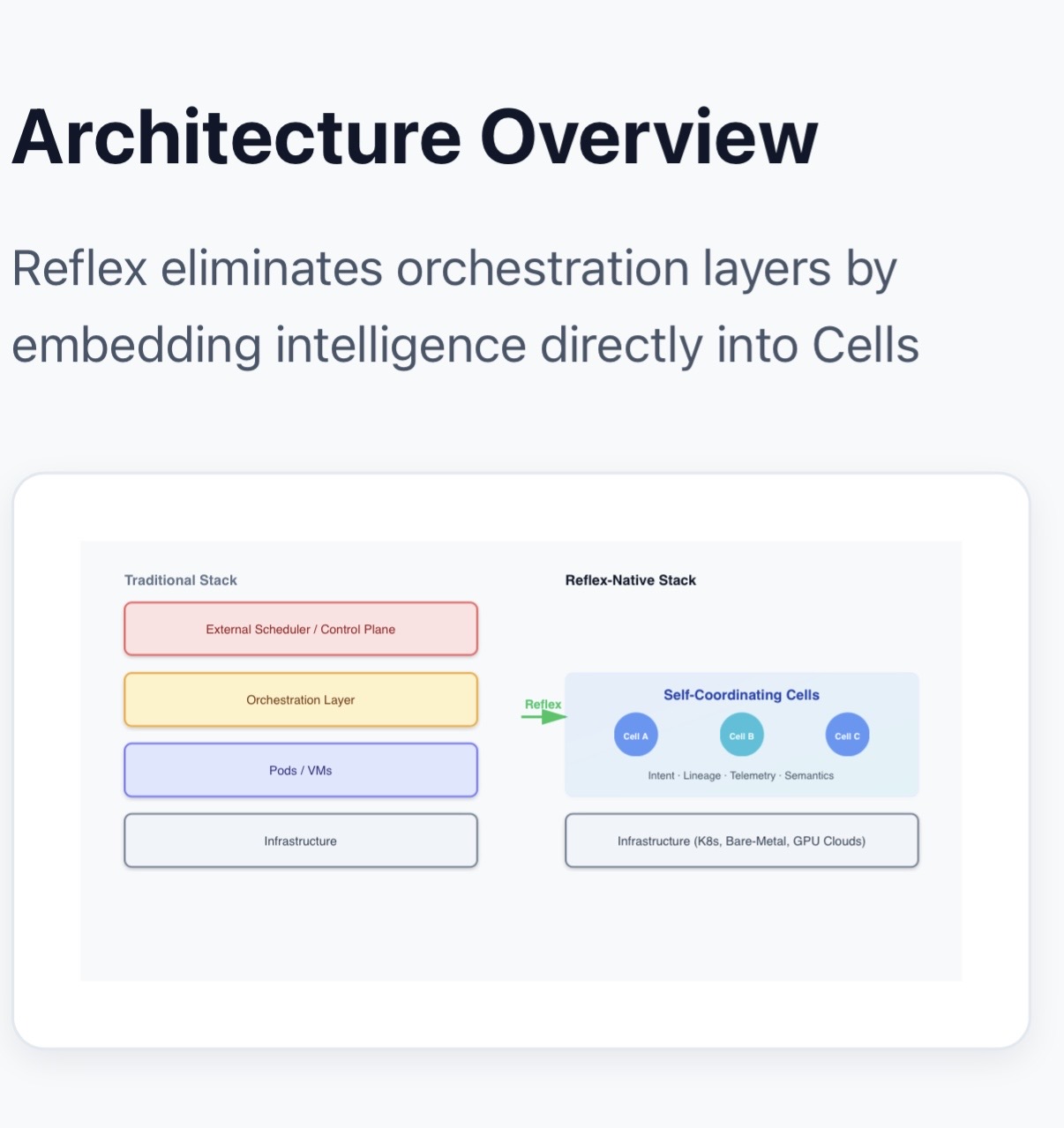
Architecture overview: traditional infrastructure with external schedulers versus Celluster reflex native execution
Reflex native execution removes orchestration, controllers, schedulers, and agents by embedding intelligence directly into Cells.

Why Celluster

Reactive infrastructure vs reflex native execution

Dimension Current Infrastructure Celluster
Control Model Orchestration, controllers, schedulers, and agents live outside the workload Control exists inside execution (Cell)
Placement Static upfront placement from manifests, telemetry, and generalized algorithms Adaptive placement aligned with workload behavior
Adaptation Restart, requeue, migration, or delayed reactive correction Continuous in place reflex adaptation
Behavior Visibility Indirect, symptom driven, telemetry based Direct, execution aware, behavior aligned
Operational Overhead High control plane overhead, policy overhead, lifecycle overhead Lower coordination overhead because control is inside execution
Upgrade / Migration Rolling restarts, drain cycles, migration events Intent driven continuity and reflex transition
Security External proxies, sidecars, policy engines Intent bound security inside execution semantics

Where Celluster Fits

Celluster fits where behavior, coordination, and execution matter most.

Layer Examples Celluster Role
GPU / AI Clusters Lambda, CoreWeave, on prem GPU fabrics Turns GPU islands into a reflexive execution fabric.
Kubernetes / Cloud Infra AWS EKS, GKE, on prem Kubernetes Operates inside, beneath, or alongside existing environments without depending on orchestration.
Network Policy Layer Calico, Cilium style policies Lifts policy from external control loops into intent bound execution semantics.
Sidecars & Service Logic Service mesh, proxies, sidecars Absorbs sidecar behavior into Cells, reducing overhead and control churn.
Data Center Design Cisco, Arista, Equinix style environments Models topology and behavior as a reflex graph rather than a static operations stack.
Edge / Real Time Systems Automotive, robotics, trading, telco Responds to live conditions without waiting for centralized reactive loops.
Private 5G / Campus Private 5G cores, UPF, campus environments Turns slices, users, and reachability into execution aware semantics.
Distributed Execution Environments Heterogeneous hosts, accelerators, networks, and workload runtimes Preserves executable intent, continuity, identity, policy, and reflex behavior across changing infrastructure boundaries.
HPC / Research / Aerospace Quantum control systems, HPC labs, edge mission systems Enables intent bound execution under extreme locality, reliability, and security constraints.

Design Partner Program

Work directly with the Celluster team to shape the future of execution-native infrastructure.

Celluster is working with a limited number of design partners building next-generation AI infrastructure, GPU fabrics, distributed systems, and execution platforms. Design partners help validate real workloads while influencing the evolution of execution-native semantic compute.

Design Partner Benefits

  • Early access to Celluster execution technology
  • Direct collaboration with the founder
  • Influence roadmap and execution capabilities
  • Evaluate production workloads

Who this fits

  • Enterprise AI infrastructure teams
  • GPU cloud / infra platforms
  • Research and advanced computing environments

Talent and academic signal

Celluster is opening around research, internships, and curriculum interest.

As runtime maturity and execution authoring become publicly available, Celluster is also becoming a vehicle for research exposure, advanced systems learning, and internship participation around the next generation of execution infrastructure.

Release 1 · Execution Authoring Preview

See the Cell before it executes.

Celluster Execution Authoring Preview is available now.

One authored Cell. One Cell Life Surface. Multiple ways to understand its life.

Open an authored .cell execution contract through the flagship Cell Life experience, then explore Semantic, Relationships, Lifecycle, Adaptation, focused perspectives, the navigable Cell Life HTML, and the Cell Life film.

Preview & Evaluation

Celluster Execution Authoring Preview contains proprietary Celluster technology and is provided for evaluation under the accompanying terms. Celluster technology and associated intellectual property remain the property of Celluster.

Native & Container

macOS · Apple Silicon

arm64 · Release 1 · ≈19 MB

Native Cell Life evaluation for Apple Silicon. Build and architecture verified.

Download for Apple Silicon

macOS · Intel

x86-64 · Release 1 · ≈19 MB

Native Cell Life evaluation for Intel Macs. Packaged Release-1 execution validated.

Download for Intel Mac

Linux · x86-64

amd64 · Release 1 · ≈19 MB

Native Cell Life evaluation for Linux x86-64. Packaged Release-1 execution validated.

Download for Linux

Container · Linux x86-64

amd64 · Release 1 evaluation envelope

A familiar evaluation envelope for the same Release-1 Cell Life experience. The container packages Celluster; it does not define Celluster's execution model.

Windows · Docker Desktop

x86-64 · WSL 2 · Release 1 container experience

Experience the same Release-1 Cell Life Surface on Windows through Docker Desktop and its Linux-container engine.

Windows native validation is planned; Windows x86-64 is available now through Docker Desktop. Mobile visitors can experience Celluster through the Cell Life visual experience and film.

Release 1 · Container Access

Familiar packaging. A different execution model.

Run the public Celluster Execution Authoring Preview through a familiar container workflow, then inspect a Cell whose authored intent, evidence, Reflex behavior, and continuity remain part of execution itself.

Public GHCR artifact · Linux x86-64 · No GitHub sign-in required
The container is the evaluation envelope, and not the execution model.

Celluster is not a container orchestrator, controller, agent, sidecar, or deployment abstraction. Inside this envelope, Cell Life reveals the authored execution contract, execution evidence, Reflex evaluation, bounded response, and continuity carried by the Cell.

1 · Pull the public Release-1 image
docker pull ghcr.io/celluster/celluster-execution-authoring-preview:r1
2 · Open Cell Life

This opens the included authored Cell in the Cell Life Surface. Cell Life renders the Cell’s projected execution story in your terminal, then returns control to your shell.

docker run --rm -it \
  ghcr.io/celluster/celluster-execution-authoring-preview:r1 \
  life /celluster/AUTHORED-CELL/llm-serving-execution.cell

Continue through Cell Life

Reopen the same authored Cell through each primary perspective. Every command returns control to your shell when that perspective is complete.

Semantic
docker run --rm -it ghcr.io/celluster/celluster-execution-authoring-preview:r1 life /celluster/AUTHORED-CELL/llm-serving-execution.cell --lens=semantic
Relationships
docker run --rm -it ghcr.io/celluster/celluster-execution-authoring-preview:r1 life /celluster/AUTHORED-CELL/llm-serving-execution.cell --lens=relationships
Lifecycle
docker run --rm -it ghcr.io/celluster/celluster-execution-authoring-preview:r1 life /celluster/AUTHORED-CELL/llm-serving-execution.cell --lens=lifecycle
Adaptation
docker run --rm -it ghcr.io/celluster/celluster-execution-authoring-preview:r1 life /celluster/AUTHORED-CELL/llm-serving-execution.cell --lens=adaptation

Inspect the authored Cell and guidance

Copy the complete frozen Release 1 material from the image to this computer. Docker creates the temporary container without running it.

Copy Release 1 to this computer
container_id=$(docker create ghcr.io/celluster/celluster-execution-authoring-preview:r1)
docker cp "${container_id}:/celluster/." ./Celluster-Release-1
docker rm "${container_id}"

Begin with ./Celluster-Release-1/START.html. Inspect the authored contract at ./Celluster-Release-1/AUTHORED-CELL/llm-serving-execution.cell. The Cell Life, Companion, Release, evaluation, and verification material remain together in the copied Release 1 folder.

Immutable SHA-256 digest sha256:5b63f4a30e33b9377b13fdb133e30bc98ed631f57244f908c2855c8a866937d0

Docker is used only to deliver the Release-1 evaluation artifact. No Kubernetes, controller, agent, sidecar, or external orchestrator is required. Evaluation terms and notices are included in the image and linked from the Release-1 selector.

Release 1 · Windows Access

Experience Cell Life on Windows.

Run the public Celluster Execution Authoring Preview from PowerShell or Windows Terminal through Docker Desktop's WSL 2 Linux-container engine.

Windows x86-64 host · Public GHCR artifact · No GitHub sign-in required
Before you begin

Install and start Docker Desktop for Windows. Use the WSL 2 based engine and Linux containers. Docker Desktop normally enables the WSL 2 engine by default on a supported Windows system.

1 · Confirm the Linux-container engine
docker info --format '{{.OSType}}'

The command above should print linux. If it prints windows, switch Docker Desktop to Linux containers and run the check again.

2 · Pull the public Release-1 image
docker pull ghcr.io/celluster/celluster-execution-authoring-preview:r1
3 · Open Cell Life

This opens the included authored Cell in the Cell Life Surface. Cell Life renders the Cell’s projected execution story in your terminal, then returns control to PowerShell.

docker run --rm -it ghcr.io/celluster/celluster-execution-authoring-preview:r1 life /celluster/AUTHORED-CELL/llm-serving-execution.cell

Continue through Cell Life

Reopen the same authored Cell through each primary perspective. Every command returns control to PowerShell when that perspective is complete.

Semantic
docker run --rm -it ghcr.io/celluster/celluster-execution-authoring-preview:r1 life /celluster/AUTHORED-CELL/llm-serving-execution.cell --lens=semantic
Relationships
docker run --rm -it ghcr.io/celluster/celluster-execution-authoring-preview:r1 life /celluster/AUTHORED-CELL/llm-serving-execution.cell --lens=relationships
Lifecycle
docker run --rm -it ghcr.io/celluster/celluster-execution-authoring-preview:r1 life /celluster/AUTHORED-CELL/llm-serving-execution.cell --lens=lifecycle
Adaptation
docker run --rm -it ghcr.io/celluster/celluster-execution-authoring-preview:r1 life /celluster/AUTHORED-CELL/llm-serving-execution.cell --lens=adaptation

Inspect the authored Cell and guidance

Copy the complete frozen Release 1 material from the image to Windows. Docker creates the temporary container without running it.

Copy Release 1 to Windows
$container = docker create ghcr.io/celluster/celluster-execution-authoring-preview:r1
docker cp "${container}:/celluster/." .\Celluster-Release-1
docker rm $container

Begin with .\Celluster-Release-1\START.html. Inspect the authored contract at .\Celluster-Release-1\AUTHORED-CELL\llm-serving-execution.cell. The Cell Life, Companion, Release, evaluation, and verification material remain together in the copied Release 1 folder.

Immutable SHA-256 digest sha256:5b63f4a30e33b9377b13fdb133e30bc98ed631f57244f908c2855c8a866937d0

Docker Desktop provides the Windows delivery path for the same frozen Release-1 Linux x86-64 image. Evaluation terms and notices are included in the image and linked from the Release-1 selector.

Local Runtime Verification

Validate Cell Execution Locally

Inspect reflex execution, lifecycle transitions, continuity behavior, and execution projections before distributed deployment.

Local Runtime Verification is scheduled for the end of October 2026.

It will be included as the next availability stage of the Celluster Execution Authoring Preview.

Contact Celluster

Start a Conversation

Share your infrastructure environment, execution challenge, collaboration interest, or Design Partner request.

Your submission will be delivered to nikhil@celluster.ai and used only to respond to your inquiry.