Reach
Connected Cluster
Cells can discover and reach the parts of the system they need. The cluster gives reach. It does not decide how every Cell executes.
Celluster does not scale by building a bigger scheduler, a bigger controller, or a bigger coordination system. Each Cell carries the intent for how its own execution should behave, then adapts continuously through bounded Reflexes.
One Cell can contain many workloads. Those workloads can be ordinary processes, containers, virtual machines, services, or even an entire Kubernetes cluster.
Celluster does not require you to turn everything into a new type of workload. The Cell sits around the execution and gives it authored intent: how it should behave, what it should preserve, what evidence matters, and which Reflexes it may use when conditions change.
A Kubernetes cluster can therefore become one workload inside a Cell. So can a group of VMs. So can dozens of containers. So can a process. The Cell is the execution boundary around them.
Traditional systems tend to pull more state and more decisions into shared schedulers and controllers as they grow. Celluster separates the problem.
Cells can discover and reach the parts of the system they need. The cluster gives reach. It does not decide how every Cell executes.
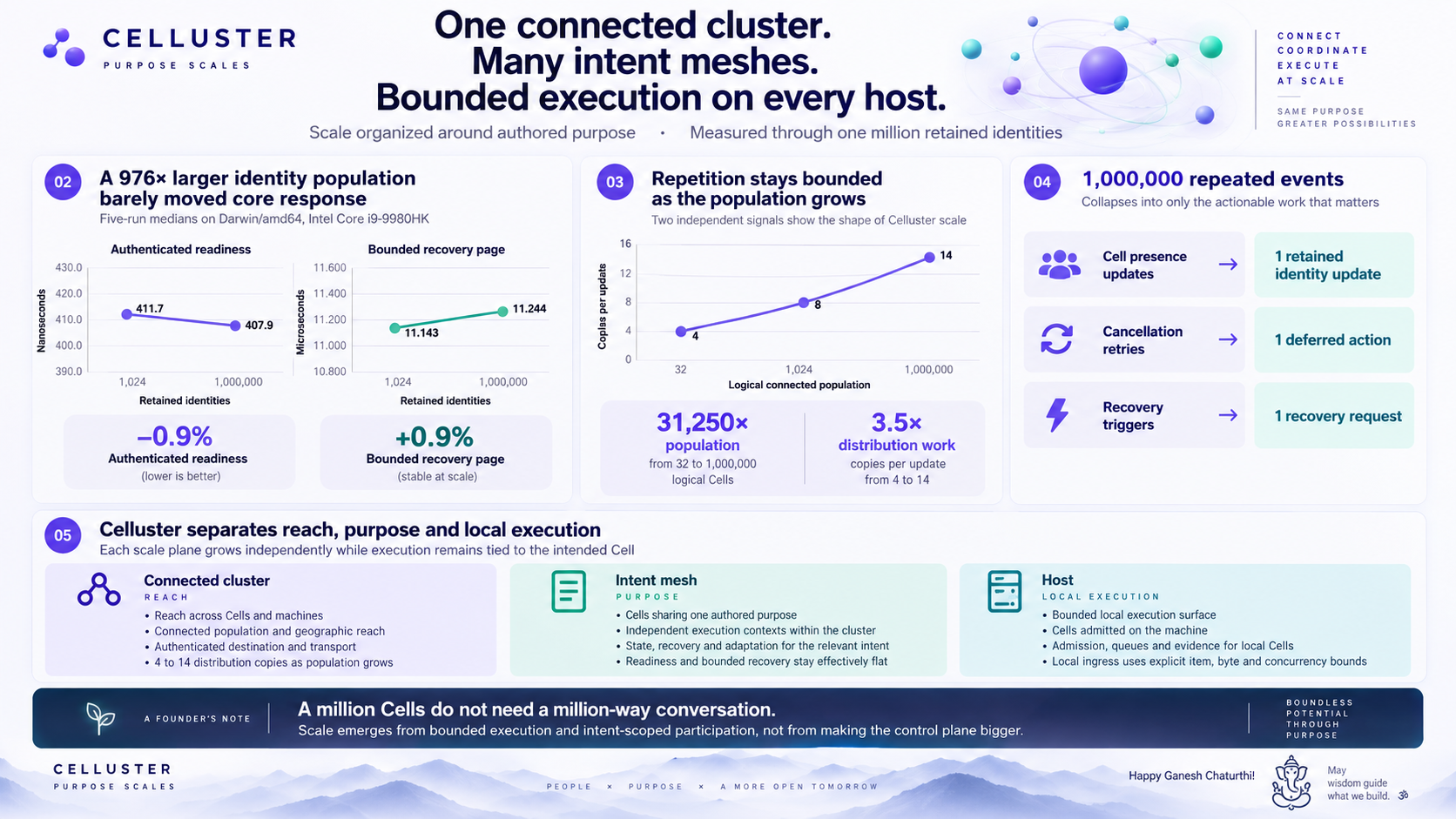
Cells with the same authored purpose participate together. Every Cell in a million-Cell system does not need to talk to every other Cell.
Each host handles the Cells actually executing there. Evidence reaches the intended Cell locally, where that Cell can evaluate its own Reflexes.
Authenticated readiness stayed essentially flat as retained population grew from 1,024 to one million.
Distribution work grew only from 4 to 14 copies per update — 3.5× work while logical population grew 31,250×.
Repeated million-event pressure can collapse into the one actionable retained state that matters.
This is the host-level proof that thousands of Cell execution boundaries can remain individually routable without turning the host into a shared scheduling bottleneck.
Distinct Cell contexts remained independently addressable while evidence reached the intended Cell and its membrane-local Provider.
The Cell-local Reflex handoff stayed in the same narrow range while logical Cell density increased.
Isolation and Cell-local Reflex behavior held as the tested Cell context population grew from 64 to 4,096.
Host-local figures shown here are from the shared benchmark material and portable host test path. Hardware-specific execution capacity still depends on what those Cells actually contain and the physical resources available.
The familiar numbers are useful for orientation, but they count different units. A Cell can wrap many of those units and govern their execution as one authored semantic boundary.
| System | What is being counted | Reference figure | Plain-English meaning |
|---|---|---|---|
| Celluster | Cell execution boundaries | 4,096 validated on one host | A Cell may contain one process, many containers, VMs, services, or even an existing Kubernetes cluster. |
| Kubernetes | Pods | 110 per node | Counts Kubernetes workload objects managed through the Kubernetes control model. |
| Slurm | Tasks | 512 per node by default | Counts scheduled task execution units. |
| AWS T3 Dedicated Host | VM instances | Up to 192 T3 instances | Counts VM instances placed on one dedicated physical host. |
| Run:ai | Kubernetes workloads | Kubernetes-dependent | Runs on Kubernetes and therefore works within the Kubernetes node/workload model. |
Celluster does not decentralize a control plane into smaller control planes. It removes the control plane as the authority over execution. Each Cell preserves its own authored execution contract, and large-scale system behavior emerges from those bounded adaptations.