Infrastructure Transformation
Move intelligence from external management layers into execution itself.
- Self-evolving infrastructure
- Continuous runtime adaptation
- Lower coordination overhead
Celluster is a self-evolving infrastructure platform powered by execution-native semantic compute, where intent is baked into execution through a reflex-native compute substrate instead of reactive control loops. Current exisitng infrastructures has been built around identity. Celluster binds identity to executable intent, allowing execution to adapt across agents, clouds, GPUs, and runtime without losing its purpose, crossing its authored safety envelope, or surrendering operational control.
Celluster introduces a new computing paradigm for distributed systems. Intent becomes executable. Identity becomes persistent. Policy becomes native behavior. Telemetry becomes continuous awareness. Adaptation becomes a deterministic reflex rather than delayed reconciliation.
Founder and architect of Celluster’s execution-native semantic compute model. Nikhil leads the company from execution architecture and Cell DSL design through runtime, kernel, networking, security, telemetry, continuity, and production-readiness engineering.
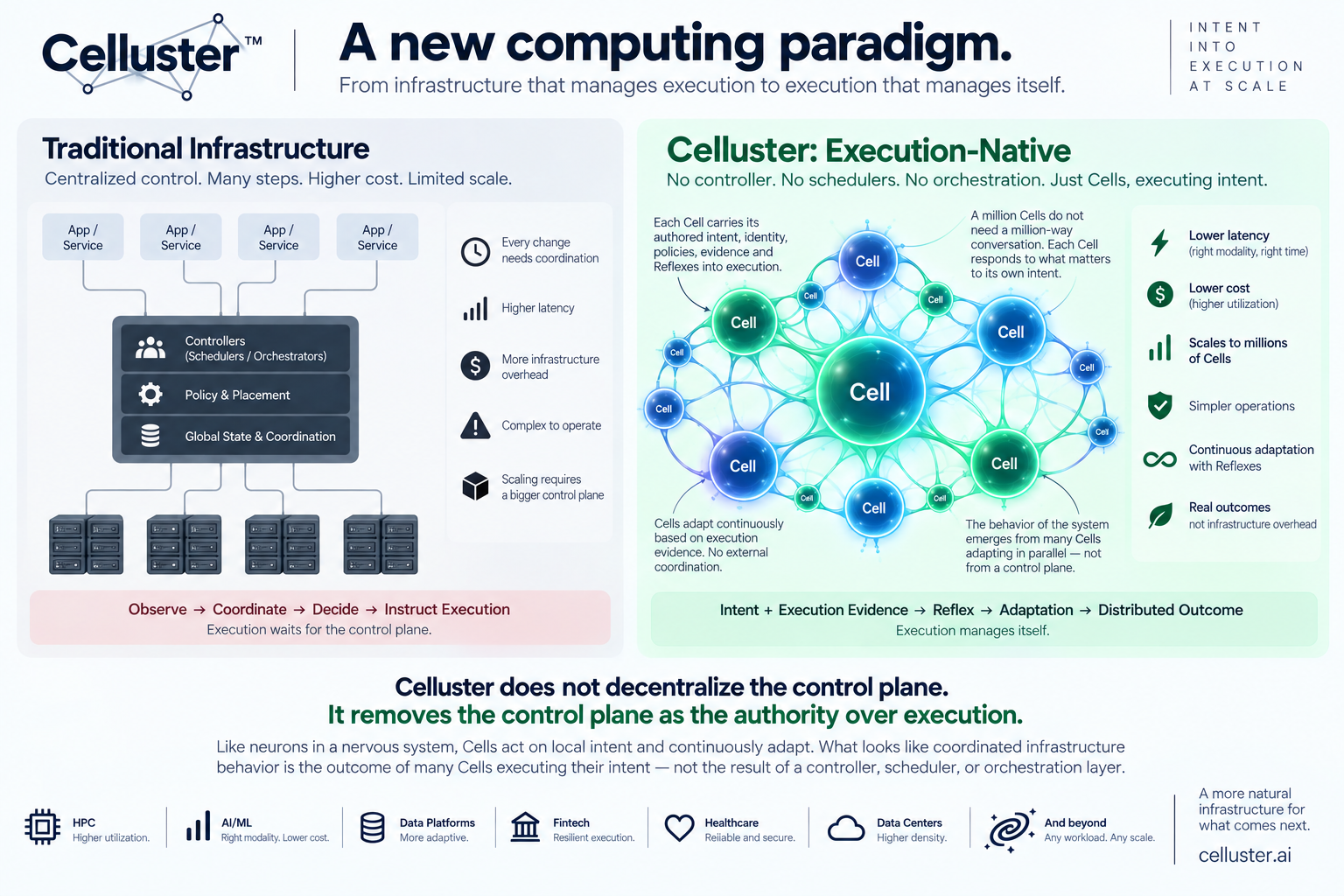
Celluster does not decentralize the control plane. It removes the control plane as the authority over execution.
A Cell behaves more like a neuron in a nervous system than a workload waiting to be managed. It carries authored intent into continuous execution, senses the conditions relevant to that intent, and adapts through bounded Reflexes.
At million-Cell scale, every Cell does not need to talk to every other Cell. There is no global coordination step producing the system’s behavior. Each Cell acts on the execution evidence, relationships, and local conditions relevant to its intent.
What appears as coordinated infrastructure behavior emerges from continuous intent-preserving adaptation across Cells.
Scale comes from execution acting on intent, not from coordinating more infrastructure.
Celluster is released in stages that mirror how execution evolves—from authoring executable intent locally to validating autonomous execution across distributed infrastructure.
| Architecture Availability | Public Name | Access | What You Get |
|---|---|---|---|
| Execution Authoring | Celluster Release 2 |
Release 2 Upcoming
|
Open an authored Cell through the Cell Life Surface: flagship whole-Cell view, Semantic, Relationships, Lifecycle, Adaptation, focused perspectives, and the packaged HTML and Cell Life film. |
| Local Runtime Verification | Included in the Celluster Execution Authoring Preview |
Public Download
|
Execute and inspect Cell behavior locally, validate reflex execution, lifecycle transitions, and execution projections before distributed deployment. |
| Distributed Execution | Celluster Design Partner Program |
Invitation / Design Partners
|
Validate the Celluster substrate across real hosts, accelerators, networks, workloads, and continuity scenarios under production-scale conditions. |
Traditional distributed systems keep execution passive and place intelligence in external schedulers, controllers, policy engines, observability systems, agents, and reconciliation loops. Celluster changes the architectural placement of intelligence: intent and adaptation become native to execution itself.
Celluster does not give workloads unrestricted authority to modify infrastructure. Every adaptation is constrained by the authored Cell contract: observable evidence, authorized reflex behavior, continuity requirements, safety gates, recovery semantics, and explicit operational controls.
The Cell declares the availability, latency, economics, utilization, recovery, and continuity outcomes execution must preserve.
Signals, metrics, baselines, and named drift establish whether execution remains inside its authored operating envelope.
Adaptation requires fresh evidence, timely evaluation, stable behavior, and no unresolved condition that requires execution to freeze.
Execution may perform only the scoped correction, movement, recovery, or decay behavior explicitly authored for that Cell.
Candidate readiness, identity, policy, lineage, service continuity, and adaptation outcome are verified before acceptance or decay.
Authorized operators can freeze reflexes, profile rebinding, preemption, overcommit, economics-driven behavior, or adaptation itself without redefining the Cell’s execution intent.
If evidence becomes stale, evaluation falls behind, adaptation oscillates, continuity cannot be preserved, or an operator freezes a behavior, execution does not continue adapting blindly. It freezes, preserves the current stable state, or restores the last healthy execution binding.
Celluster assumes authored intent may evolve, be incomplete, or contain gaps. Runtime adaptation is therefore bounded by Reflex Safety and always remains subject to Operational Override.
Execution-native semantic compute changes more than one infrastructure metric. It creates value across economics, operations, security, trust, engineering productivity, hardware return, and the long-term ability of distributed systems to evolve. AI is the first commercial beachhead. Execution is the enduring platform.
Move intelligence from external management layers into execution itself.
Reduce the expanding ecosystem required to deploy, coordinate, secure, observe, and maintain workloads.
Measure value and cost through execution behavior rather than isolated infrastructure components.
Maintain identity, lineage, policy integrity, provenance, and continuity throughout execution.
Shift engineering effort from coordinating infrastructure ecosystems toward building useful systems.
Apply one semantic execution foundation across heterogeneous industries, hardware, and future computing models.
Explore the complete commercialization thesis: the Execution Era, structural market pain, category creation, commercial outcomes, horizontal expansion, and the long-term execution platform ecosystem.
Explore CommercializationAI execution is no longer static.
Workloads shift across models, data paths, latency conditions, GPU topology, memory pressure, and coordination requirements in real time.
Current infrastructure still relies on orchestration, controllers, schedulers, and agents.
These systems do not execute intent.
They observe symptoms, infer behavior indirectly, and react after drift appears.
That model weakens as systems become more dynamic, more distributed, and more sensitive to execution behavior.
Celluster closes this gap by binding intent, telemetry, and reflex logic directly into execution.
Execution adapts from within instead of being corrected from outside.
This is not another infrastructure layer.
It is a shift in where control lives.
Modern infrastructure was designed around identity. Identity works well for authentication and authorization, but it was never designed to preserve execution semantics across distributed, adaptive systems. As workloads span agents, GPUs, clusters, and clouds, knowing who is executing is no longer enough. Infrastructure must understand what is being executed and why.
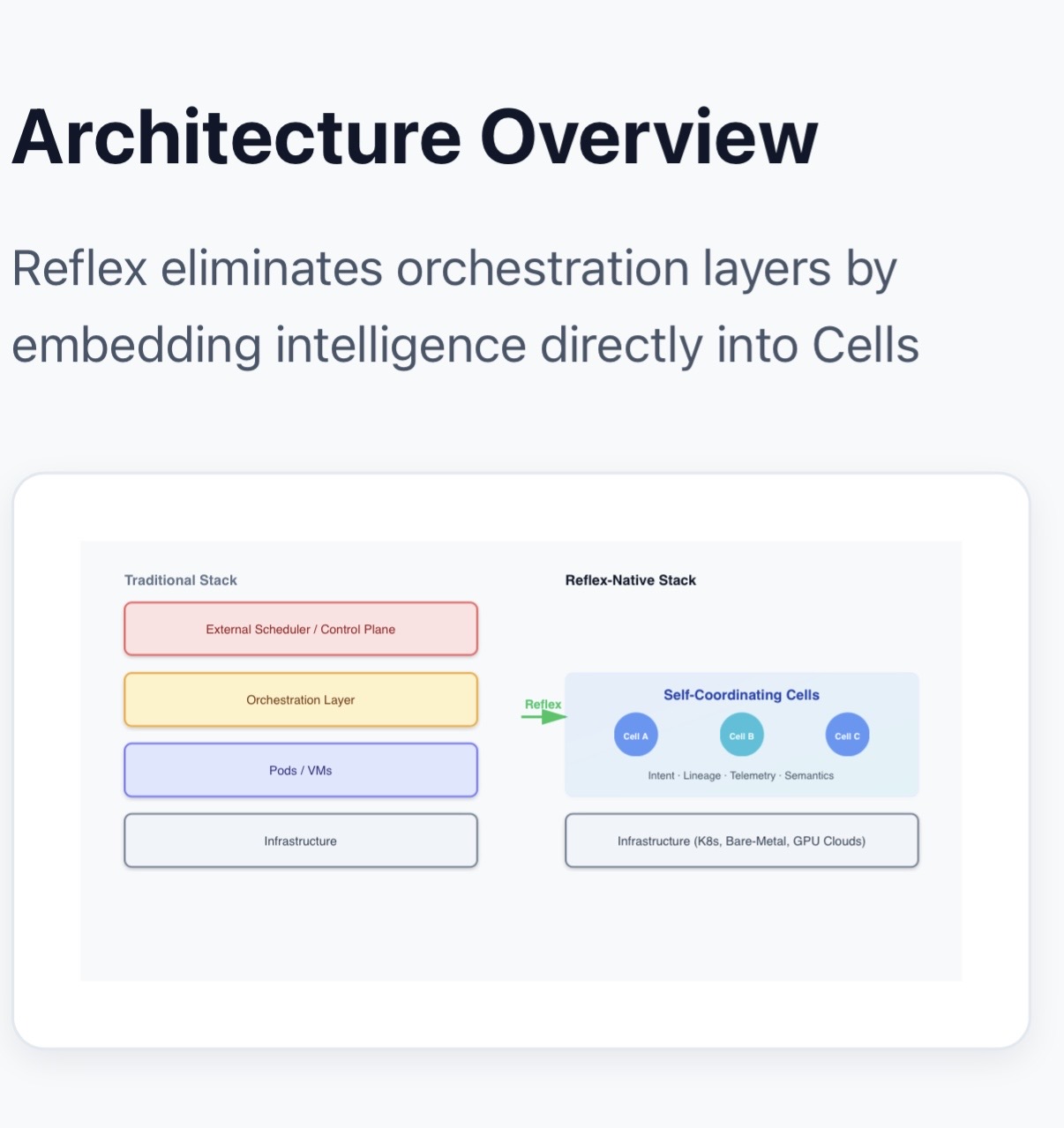
Modern AI infrastructure still depends on orchestration, controllers, schedulers, agents, reconciliation loops, and external policy layers. These systems do not execute intent. They observe telemetry, infer behavior indirectly, and then try to correct drift after it emerges.
Celluster binds intent, telemetry, and reflex logic directly to the execution unit. Instead of an external control plane driving a workload from the outside, the workload executes inside a reflex aware substrate that can adapt continuously in place.
| Dimension | Current Infrastructure | Celluster |
|---|---|---|
| Control Model | Orchestration, controllers, schedulers, and agents live outside the workload | Control exists inside execution (Cell) |
| Placement | Static upfront placement from manifests, telemetry, and generalized algorithms | Adaptive placement aligned with workload behavior |
| Adaptation | Restart, requeue, migration, or delayed reactive correction | Continuous in place reflex adaptation |
| Behavior Visibility | Indirect, symptom driven, telemetry based | Direct, execution aware, behavior aligned |
| Operational Overhead | High control plane overhead, policy overhead, lifecycle overhead | Lower coordination overhead because control is inside execution |
| Upgrade / Migration | Rolling restarts, drain cycles, migration events | Intent driven continuity and reflex transition |
| Security | External proxies, sidecars, policy engines | Intent bound security inside execution semantics |
| Layer | Examples | Celluster Role |
|---|---|---|
| GPU / AI Clusters | Lambda, CoreWeave, on prem GPU fabrics | Turns GPU islands into a reflexive execution fabric. |
| Kubernetes / Cloud Infra | AWS EKS, GKE, on prem Kubernetes | Operates inside, beneath, or alongside existing environments without depending on orchestration. |
| Network Policy Layer | Calico, Cilium style policies | Lifts policy from external control loops into intent bound execution semantics. |
| Sidecars & Service Logic | Service mesh, proxies, sidecars | Absorbs sidecar behavior into Cells, reducing overhead and control churn. |
| Data Center Design | Cisco, Arista, Equinix style environments | Models topology and behavior as a reflex graph rather than a static operations stack. |
| Edge / Real Time Systems | Automotive, robotics, trading, telco | Responds to live conditions without waiting for centralized reactive loops. |
| Private 5G / Campus | Private 5G cores, UPF, campus environments | Turns slices, users, and reachability into execution aware semantics. |
| Distributed Execution Environments | Heterogeneous hosts, accelerators, networks, and workload runtimes | Preserves executable intent, continuity, identity, policy, and reflex behavior across changing infrastructure boundaries. |
| HPC / Research / Aerospace | Quantum control systems, HPC labs, edge mission systems | Enables intent bound execution under extreme locality, reliability, and security constraints. |
Celluster is working with a limited number of design partners building next-generation AI infrastructure, GPU fabrics, distributed systems, and execution platforms. Design partners help validate real workloads while influencing the evolution of execution-native semantic compute.
As runtime maturity and execution authoring become publicly available, Celluster is also becoming a vehicle for research exposure, advanced systems learning, and internship participation around the next generation of execution infrastructure.