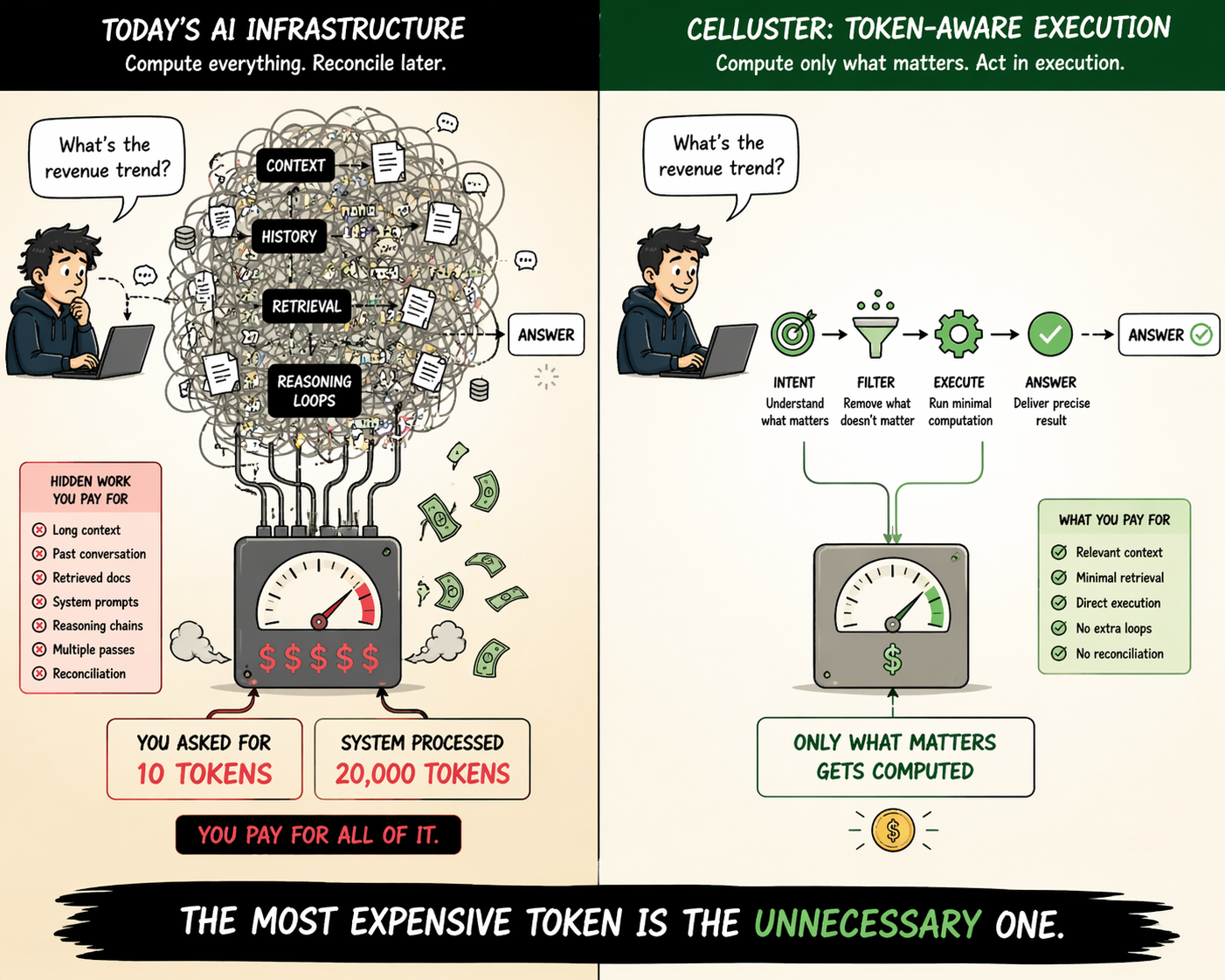
The Hidden Problem
Modern AI systems do not operate on minimal intent. They operate on expanded context:
- long conversation history
- retrieved knowledge
- system-generated reasoning chains
- cached and accumulated state
A simple query often triggers orders of magnitude more computation than necessary.
Users will pay not just for what they ask — but for everything the system decides to process.
This is an Architecture Problem
Today’s AI infrastructure is built around:
- external control loops
- post-execution reconciliation
- reactive optimization
This leads to:
- cost scaling with context, not intent
- latency driven by layered reasoning
- decision-making detached from execution
Industry Response: Optimizing the Wrong Layer
Current approaches focus on:
- GPU scheduling fairness
- model efficiency improvements
- caching and batching strategies
These optimize how efficiently compute is used.
But they do not answer: Should this computation happen at all?
Celluster: Token-Aware Execution
Celluster introduces a different model: execution-native decision making.
Instead of optimizing after computation:
- intent is defined upfront
- telemetry is observed at execution
- decisions are applied directly where computation happens
This enables:
- token-aware execution
- real-time cost control
- elimination of unnecessary computation
- alignment of infrastructure behavior with economic intent
From GPU Scheduling → To Token Scheduling
Traditional systems:
optimize GPU allocation
Celluster:
optimizes execution semantics
The problem shifts from “How do we schedule compute efficiently?” to “What should be computed at all?”
The Result
- lower cost per workload
- reduced context bloat
- faster execution paths
- infrastructure aligned with intent
A New Constraint for AI Systems
As token-based pricing becomes standard, infrastructure must become economically aware.
Not as an optimization layer — but as a core execution principle.
Celluster is built for that world.