Celluster™ IP-Less / IPAM-Less
Stop plumbing IPs. Start flowing intent.Cloud today still treats every workload as an IP endpoint: carve subnets, allocate IPs, manage DHCP, wire CNI, debug conntrack. Most of this has nothing to do with the business logic you are trying to run.
Celluster flips the stack: workloads run as Cells identified by intent, zone, and lineage. IPs become an implementation detail of the substrate, not something every team has to juggle.
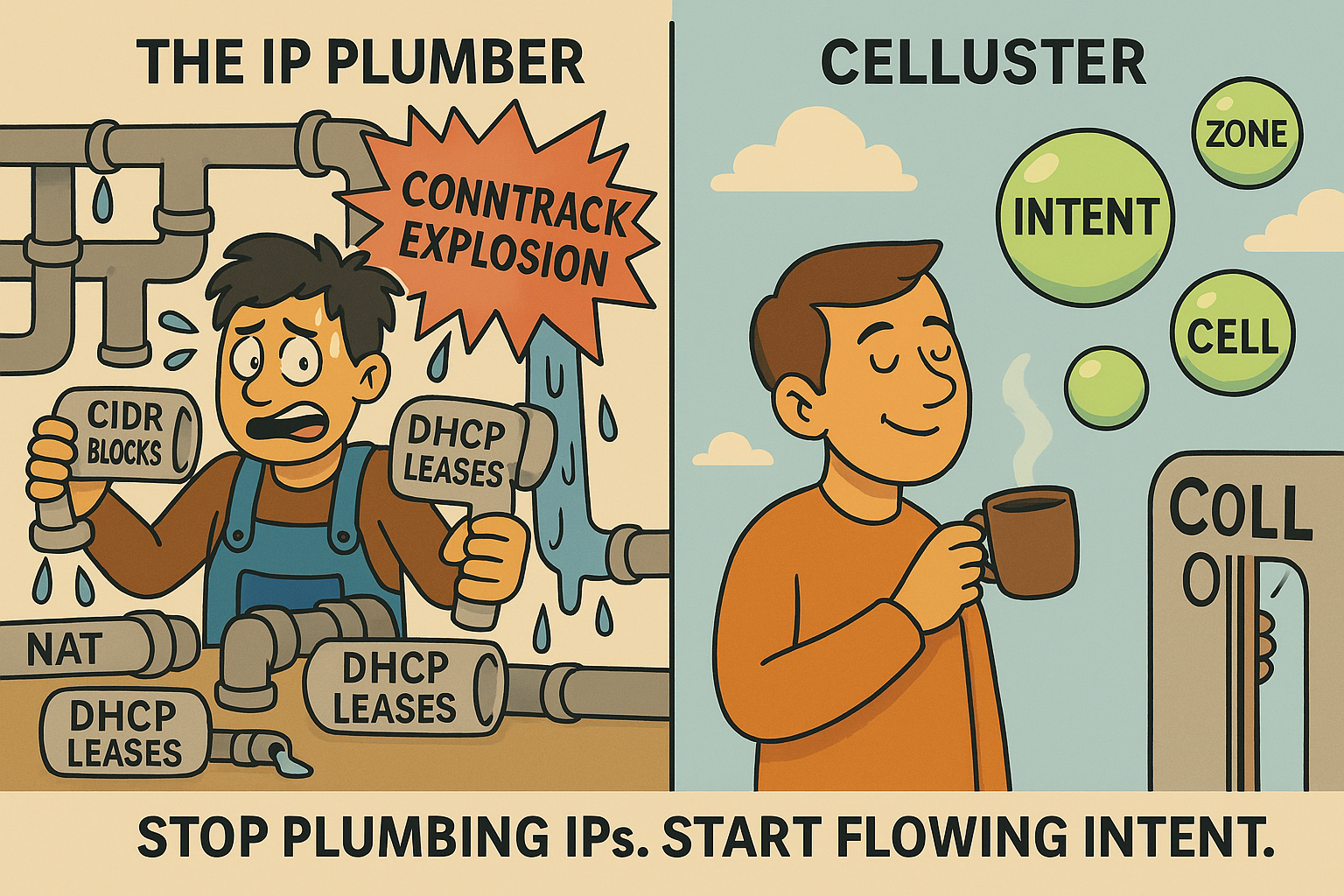
From IP Endpoints → Intent-Native Cells
Addresses are implementation. Intent is the interface.
In traditional stacks, every workload is born as an IP address. Before it can do anything useful, somebody must:
- Carve CIDR blocks and subnets.
- Run DHCP / IPAM workflows to assign addresses.
- Attach CNIs and overlays to make those addresses routable.
- Mirror the same intent again in firewall rules and policies.
Celluster starts from the opposite side:
The substrate is free to use whatever addressing is efficient underneath, while the intent graph stays stable.
The IP Plumber Problem
Every new service becomes another pipe to maintain.
If you are an SRE or network engineer, your job probably looks like plumbing:
- Expanding subnets when teams run out of IPs.
- Debugging “it worked in dev” because address plans differ across environments.
- Tracking down ghost entries in ARP, DNS, or conntrack after rollouts.
- Coordinating IP address changes with security, platform, and app teams.
None of this work is product value. It is just the cost of representing workloads as IP endpoints.
Every IP you assign is another thing to migrate later.
Celluster: IP-Less at the Edge, Not in the Kernel
We are not deleting IP. We are deleting IP from your backlog.
Celluster maintains whatever addressing it needs inside the substrate. But to operators and developers, the surface area is:
- intent: what this Cell is and how it should behave.
- zone: where it belongs (cluster, region, cloud, slice).
- tenant: who owns it.
Routing and reachability are derived from this semantic graph, not from manual IP accounting.
Think of it as: “No IPAM in your workflow. Plenty of IP where it belongs.”
IPAM & CNI vs Intent-Native Cells
What changes, what stays, and who feels it.
| Aspect | Traditional (IP / IPAM / CNI) | Celluster Cells |
|---|---|---|
| Identity | Workloads known by IP, hostname, or interface. | Workloads known by intent + zone + tenant; IP is internal detail. |
| Onboarding | Request subnet, carve CIDR, allocate IP, wire CNI, update security rules. | Declare intent; Cells are born with correct reachability and policy from the start. |
| Change | IP changes ripple into DNS, firewalls, ACLs, configs, scripts. | Change intent or zone; Cells migrate with preserved semantics. Addressing churn is absorbed by the substrate. |
| Operations | IPAM tickets, IP conflicts, CNI upgrades, overlapping CIDRs. | Operators reason about who can talk to whom, and why, not about addresses. |
| Multi-cloud | Gateways, VPN meshes, NAT, duplicated address plans. | Intent graph spans zones and clouds; Cells discover peers via semantics. |
Goodbye IPAM Queue
The IPAM bureaucrat meets intent-only Cells.
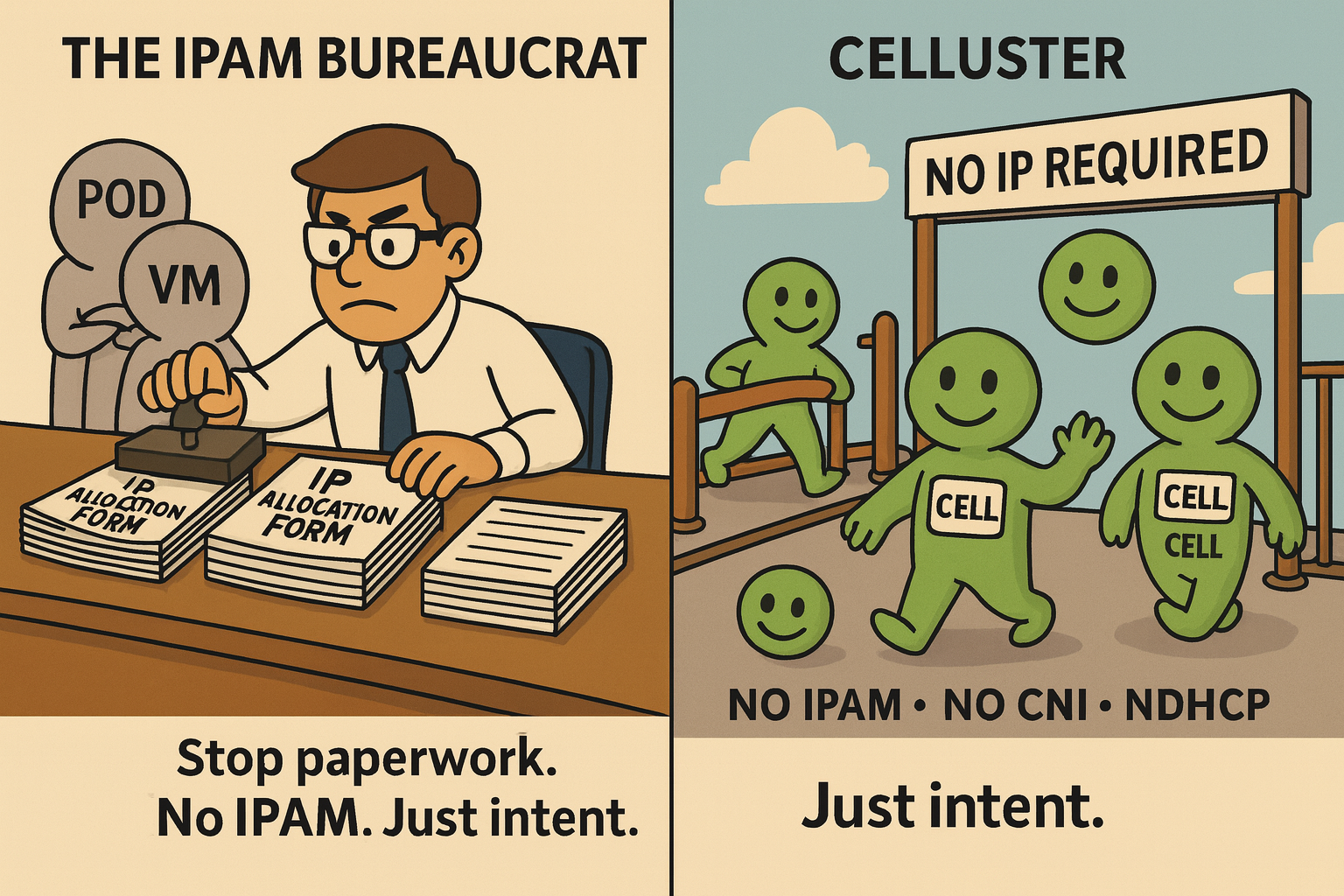
In many organisations, getting an IP address is still a ticket. With Cells, the ticket is replaced by a declaration:
- intent: api.orders.v1
- zone: eu-prod
- constraints: latency, tenant, risk band
The substrate takes care of fit, placement, reachability, and any addressing details required to make it real.